GoodGym Boosts Life Satisfaction and Mental Health
LSE Research confirms what GoodGymers already knew
Thursday 1st October
Story written by Jacob Harriss (He/Him)
Share the love
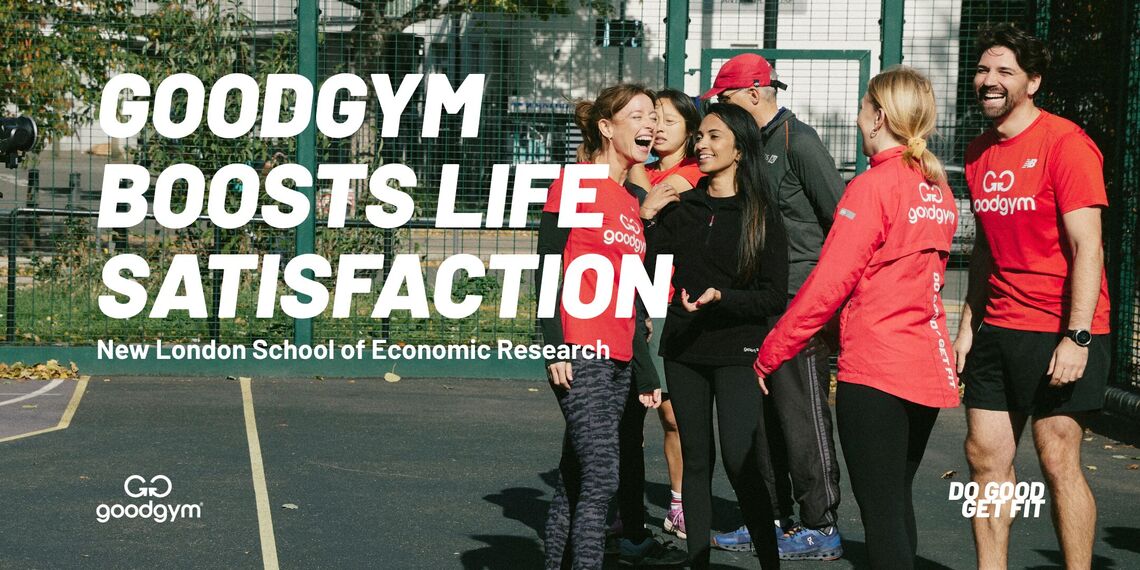
New research from the London School of Economics (LSE) found that combining exercise with volunteering through GoodGym delivers a meaningful and lasting boost to mental health, with benefits still measurable more than six months after a participant's last session.
The Headline Numbers
- Taking part in GoodGym boosts life satisfaction considerably. It is equivalent to 63% of the wellbeing boost of being employed, compared to having no job, and 73% the wellbeing boost of having a partner, compared to being single.
- Mental health, loneliness, belonging, connectedness, and trust all improved significantly among participants compared with people who signed up but never took part.
- These benefits remain detectable more than six months after someone's last session.
- The estimated wellbeing benefits generated by GoodGym are more than 40 times greater than the cost of running the programme.
Building on Years of Evidence
This is the second major evaluation of GoodGym conducted by LSE. Back in 2024, researchers found that GoodGym participation was associated with a:
- 21% increase in life satisfaction
- 27% increase in belonging
- 16% increase in connectedness
- 21% reduction in mental distress
- 12% reduction in loneliness
You can read that full evaluation here.
The evaluation, led by Dr Christian Krekel and published in September 2026, surveyed more than 3,600 people comparing respondents answers pre and post sign up to a GoodGym session. This allowed a direct comparison both individually - the difference in score from the same person, before and after attending - and in those who signed up but didn’t choose to attend.
What the Data Shows
Mental health improves, and it lasts
Participants showed a meaningful reduction in symptoms of anxiety and depression, still measurable more than six months after their last session. This isn't a short-term mood boost - it's a lasting shift.
You don't need to do loads to feel it
Mental health benefits showed up even among people who'd taken part four times or fewer. The more you come, the bigger the gains, but the benefit starts from your very first sessions.
Belonging, connectedness, and trust build over time
These outcomes take a bit more sustained involvement to land fully. Belonging and connectedness grow from relatively early on, while the biggest gains in trust and drop in loneliness show up for the most regular GoodGymers.
It works for everyone, in different ways
Low-income participants gained just as much as higher-income participants. The programme was equally effective across every age group, with slightly stronger connectedness gains for younger participants. Men tended to see bigger mental health improvements; women tended to see bigger gains in trust and belonging.
It's an economic no-brainer
The estimated wellbeing benefits generated by GoodGym are more than 40 times greater than the cost of running it.
In the Researcher's Words
"GoodGym is a really good idea," says Dr Christian Krekel. "Why waste time in a gym if one can exercise together with other people in one's local area, while also helping the community? At scale, programmes like this could offer a simple and practical way to improve wellbeing while strengthening social connection in communities."
GoodGym CEO, Hannah Crane concludes, “For all those involved in GoodGym this report validates what we already know - we are onto a good thing! Doing something useful alongside someone else who cares about the community I live in - what a great recipe for feeling good.”
Why It Matters
This research proves what GoodGymers feel every week: showing up works. It doesn't matter if you're 19 or 60, on a low income or a high one, brand new or a long-time regular - the benefits are real, and they last. The more you come, the more you gain, but you don't need a perfect attendance record to feel the difference.